 English
導入
A gym owner decides to send out a spring offer to everyone on an old sign-up sheet via text message. They send out the message to a few thousand numbers. However, some customers didn't give permission to be contacted via text. A few weeks later a letter comes through from a lawyer.
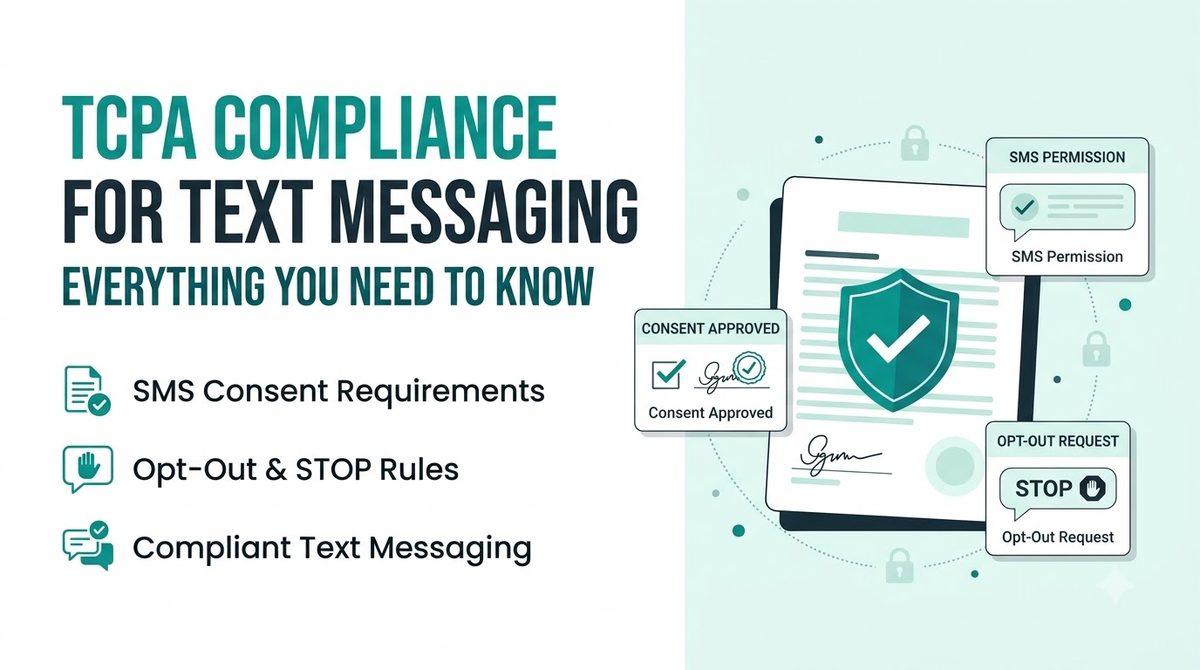
Although this scenario isn't real, there is a real issue. In the US, there are federal regulations in place for contacting customers via text messaging for marketing, and TCPA text messages are a big part of that. TCPA compliance ensures you're on the right side of it.
This guide explains the TCPA, including what texts fall under it, penalties and how to comply. It's a general overview and we recommend consulting a lawyer to find out how it affects your business. We checked the rules below against the text of 47 CFR 64.1200 and 47 U.S.C. 227 in November 2026.
重要なポイント
- The TCPA is a federal law restricting marketing calls and texts. The rules are detailed by the FCC in 47 CFR 64.1200.
- Any marketing texts sent using an autodialer require prior express written consent.
- Customers can withdraw their permission at any time by using any sensible method. This includes STOP, QUIT, END, REVOKE, OPT OUT, CANCEL and UNSUBSCRIBE.
- Under the law, you can owe $500 per violation. However, if you're found to be willfully or knowingly in violation, it can be up to triple that amount.
- Make sure you have evidence of permission, respond quickly to withdrawals and text at the correct times.
What Is TCPA Compliance?
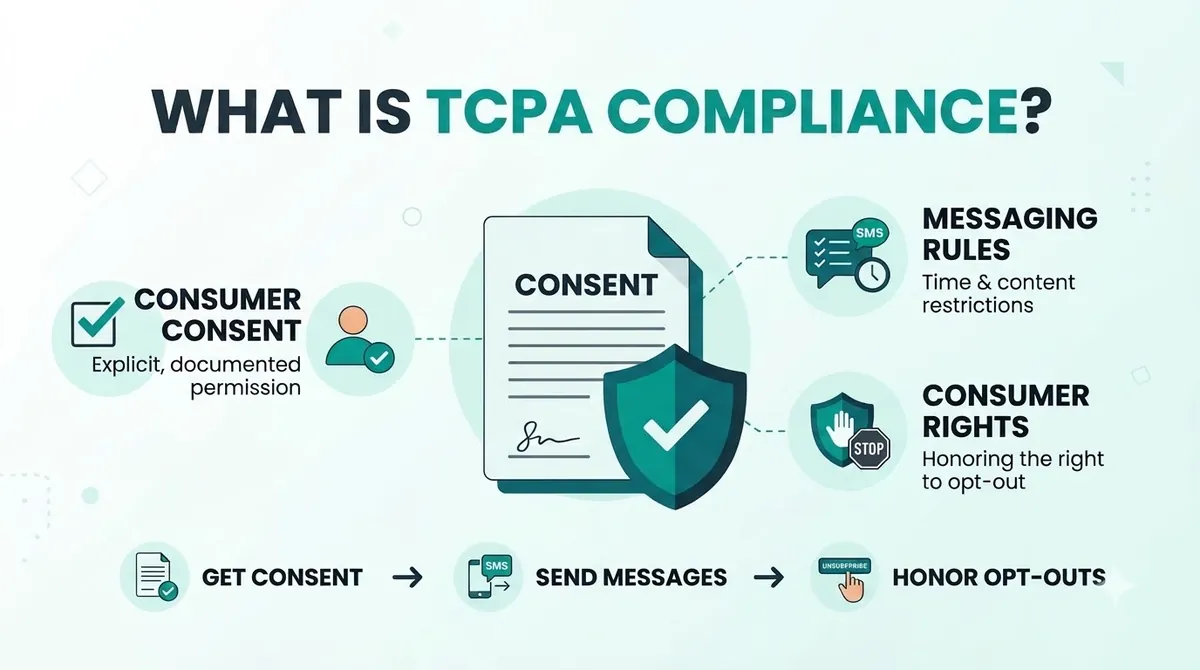
The Telephone Consumer Protection Act (TCPA) is a US federal law relating to calls and texts. It can be found in the US Code at 47 U.S.C. 227. The FCC has created detailed rules for it, which can be found here: 47 CFR 64.1200.
TCPA compliance is making sure you're following these rules. Overall it comes down to getting permission, letting people withdraw, sensible times and having evidence. The rules apply to texts and calls.
The FCC's opt-out rule says this directly. It uses the words "calls or text messages".
TCPA Text Message Rules at a Glance
| Rule | What it asks of you | Where it comes from |
|---|---|---|
| Consent | Prior express written consent for marketing texts sent with an autodialer | 47 CFR 64.1200(a)(2) |
| Disclosures | Clear wording that the person agrees to marketing messages and doesn't have to agree to buy anything | The rule's definition of written consent |
| Opt-outs | Honor any reasonable request to stop, within ten business days at most | 47 CFR 64.1200(a)(10) |
| Quiet hours | No telephone solicitations before 8 a.m. or after 9 p.m. local time | 47 CFR 64.1200(c)(1) |
| Do Not Call | No solicitations to numbers on the National Do Not Call Registry | 47 CFR 64.1200(c)(2) |
| Internal policy | A written do-not-call policy, trained staff and recorded requests | 47 CFR 64.1200(d) |
| Penalties | $500 per violation, up to three times that if willful or knowing | 47 U.S.C. 227(b)(3) |
TCPA Penalties: Why Compliance Matters
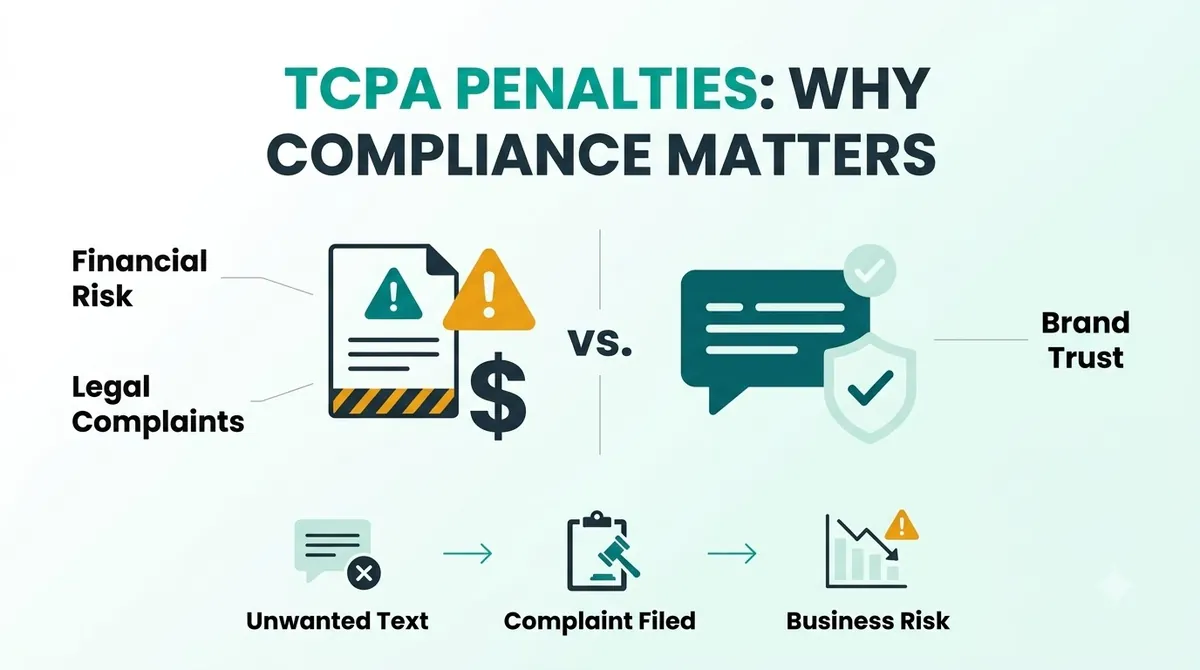
With the TCPA, people can bring a claim in state courts if permitted by state law. Under the statute anyone can claim compensation for their actual loss or $500 per violation. If you're found to be willfully or knowingly in breach, a court can award up to triple the amount.
This can add up quickly when you're reaching out to a lot of people. The FCC can also fine you. Getting permission is central to a good texting strategy.
Which Texts Does the TCPA Apply To?
The most restrictive rules apply to telemarketing. The FCC rule defines telemarketing as a call or message that encourages the purchase or rental of property, goods or services.
This would include any promotions, coupons, flash sales or product announcements. If you're encouraging a sale then you're marketing.
Informational messages such as order updates or appointment reminders are treated differently. There are also exclusions for some health care messages. We explain the differences between transactional SMS and promotions in our transactional SMS guide.
If unsure, always go for the stricter option.
TCPA Compliance Checklist for Texting
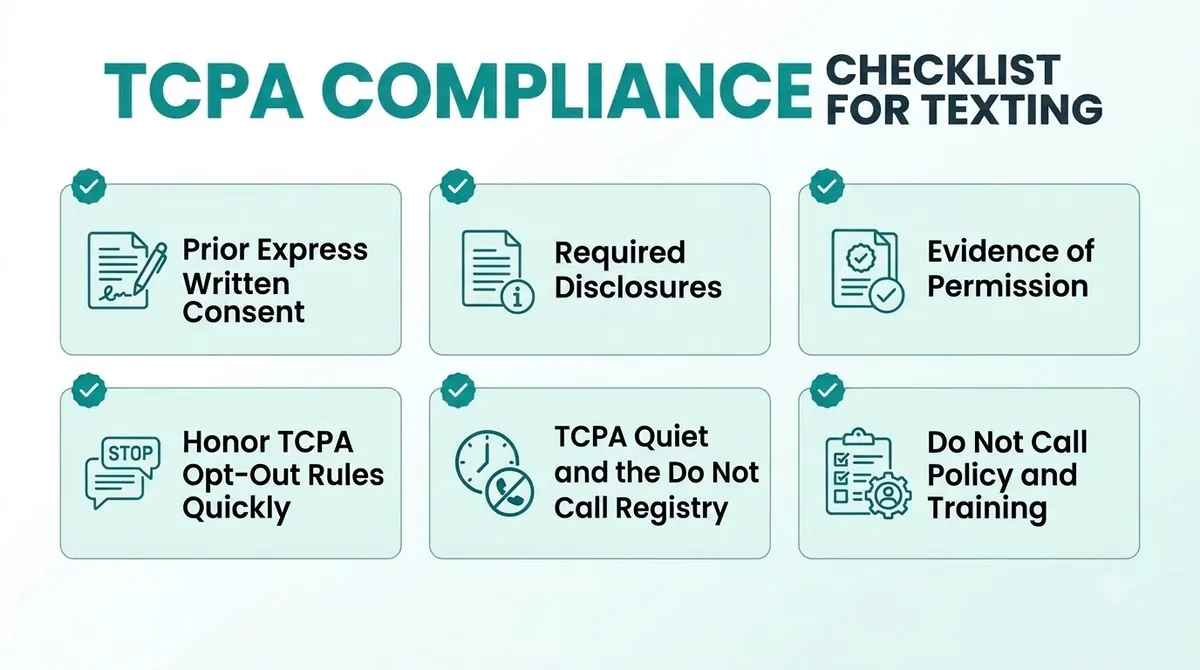
1. Prior Express Written Consent
If you're sending a marketing text using an automatic telephone dialing system, you need prior express written consent. This is defined by the FCC as getting permission through a signed written agreement. The agreement needs to give clear permission to send marketing messages. It also needs to include the phone number.
You can use electronic or digital signatures. This could be a checkbox on a website or a keyword reply. Good TCPA consent starts with your SMS opt in form, so it's worth getting that right.
2. Required Disclosures
The agreement must make clear to the customer that by signing they are authorizing you to send marketing messages using an autodialer or pre-recorded voice. It also needs to state they are not required to agree to this to purchase anything.
This should be displayed next to the sign-up button. Ask your lawyer to check. Here's wording a lot of businesses start from:
“By checking this box, I agree to receive marketing text messages from Your Business at the number I entered. Messages may be sent with an automatic dialing system. Consent is not a condition of any purchase. Message and data rates may apply. Reply STOP to cancel.”
3. Evidence of Permission
You'll need evidence if a customer claims they never gave you permission. The CTIA recommends noting down when they gave their permission, how they did so and what they saw. This can be found in their Messaging Principles and Best Practices.
This should be stored for every contact. At a minimum, this should be put into a spreadsheet. Ideally use a messaging platform that tracks this automatically.
4. Honor TCPA Opt-Out Rules Quickly
Customers can withdraw their permission to be contacted by any sensible method. Any reply with the words STOP, QUIT, END, REVOKE, OPT OUT, CANCEL or unsubscribe will count. If the customer uses other wording, it still counts if a reasonable person would understand it to be an opt-out.
You cannot specify any one method. You must honor requests within a sensible time frame (no longer than 10 business days). Ideally stop texting immediately.
You can send a single confirmation text after they've opted out. This shouldn't be marketing and should be sent within 5 minutes. Add simple SMS opt out language like "Reply STOP to opt out" to your messages. See our guide on two-way texting for more details.
5. TCPA Quiet Hours and the Do Not Call Registry
The FCC rule states you shouldn't make telephone solicitations to residential subscribers before 8am or after 9pm in their local time. The TCPA do not call rules also stop you contacting numbers on the National Do Not Call Registry.
Many businesses avoid trouble by texting between 8am and 9pm. They also clean their lists of numbers on the registry. This is an easy habit to get into.
There's one catch. A federal court in Delaware (King v. Bon Charge, decided April 30, 2026) threw out a quiet hours claim because the person had agreed to get the texts. The same court let a Do Not Call claim carry on, as there was no signed written agreement. That's one court, so it doesn't bind the others. A law firm's write-up says courts may well disagree. Stay inside the window and check the customer's time zone, not yours.
6. Do Not Call Policy and Training
Any business making telemarketing calls must have systems in place to manage a Do Not Call list. The FCC rule outlines the minimum standards you must follow. You'll need a written policy that can be provided on request. All staff involved in making telemarketing calls must be trained. You must also log any opt out requests.
This is often overlooked by small teams. Simply write a one-page policy and share it with your team. Update it when your tools change.
Common TCPA Compliance Mistakes
- Using old or purchased lists. Just because the customer is on the list doesn't mean they've given permission. The CTIA also recommends you don't use rented, sold or shared opt-in lists.
- Vague permission. An "I agree to the terms" checkbox may not satisfy written permission.
- No evidence. If you don't have evidence of when and how they opted in, you won't be able to defend your text.
- Ignoring "please stop". Customers may not always type STOP in uppercase.
- Texting late. Sending a promotion late at night is a risk, and 7pm in California is 10pm in New York.
- Opt-outs not applied across all lists. If a customer opts out on one tool, you must update all lists.
- Thinking permission carries over. The CTIA says an opt-in only applies to the program the customer agreed to.
TCPA Compliance for Small Business: Where to Start
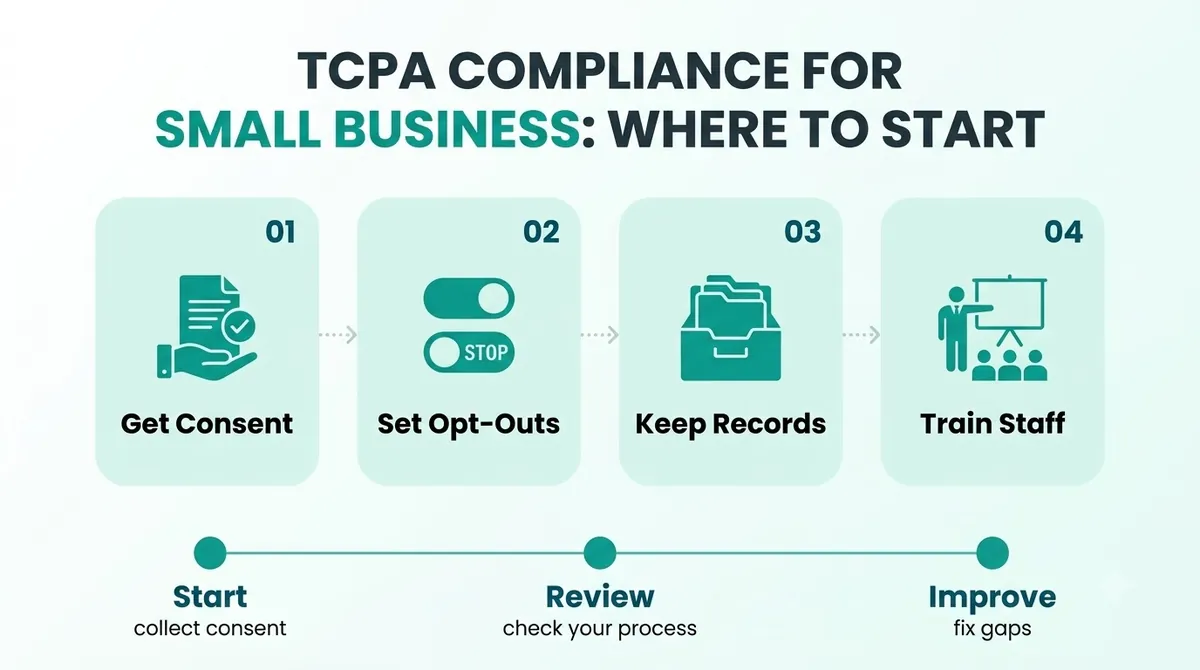
You don't need a legal team to get the basics right. Start with three things this week:
- Fix your sign-up form so it has clear written permission wording.
- Start a simple consent log. A spreadsheet is fine.
- Set a sending window of 8am to 9pm in your customer's time zone.
Then pay a lawyer for an hour to check the wording. It costs far less than a claim.
TCPA Compliance and 10DLC Registration
TCPA は法律であり、10DLC 登録は通信事業者の要件です。 TCPA SMS コンプライアンスとキャリア ルールは 2 つの別個の作業であるため、両方を行う必要があります。
ブランドとキャンペーンを登録すると、メッセージが伝わりやすくなります。それでも許可の必要性に代わるものではありません。通信事業者は、人々がどのようにオプトインしているかの証拠も求めています。 10DLC登録ガイド for more details.
あなたの州には追加の規則がありますか?
多分。一部の州には独自のテキストメッセージ法が定められています。顧客が居住する各州の規則を確認してください。大規模なキャンペーンを行う予定がある場合は、弁護士に相談してください。
SMSLocalを使用したTCPA準拠
メッセージング プラットフォームを使用すると、配信と追跡に役立ちます。ただし、許可を得ていることを確認するのはユーザーの責任であり、SMS マーケティングのコンプライアンスは、使用するツールに関係なく送信者の責任となります。 SMSLocal を使用している場合は、これを自分で追跡する必要があります。キャンペーンを開始する前に、オプトアウトの処理方法を設定します。と話してください SMSLocal チーム アカウントに対する返信とオプトアウトがどのように機能するかを確認してください。
テキストメッセージ送信全般について詳しく知りたい場合は、簡単なガイドをご覧ください。 SMSマーケティングとは何ですか.
信頼性が高く、迅速かつ効果的なコミュニケーションにより、メッセージを目立たせることができます。今すぐあなたのテキストメッセージングゲームをレベルアップしましょう。
結論
TCPA への準拠は習慣化する必要があります。明確な書面による許可と証拠を持っていること、オプトアウトに迅速に対応すること、適切なタイミングでテキストメッセージを送信すること、チームに電話禁止ポリシーを導入していることを確認してください。
それが完了すると、テキストを擁護するのが簡単になり、顧客はテキストに対する信頼をさらに高めることができます。不明な点がある場合は、弁護士に質問してください。
SMSLocal の無料トライアルを開始して、登録された信頼できるメッセージを送信してください。
よくある質問
It means following the TCPA and the FCC's rules when you text people. You need the right permission, an easy way to opt out, sensible sending times and records to back it all up.
Yes. The FCC's rules cover texts as well as calls. The opt-out rule even says "calls or text messages".
A signed, written agreement that clearly lets a business send marketing messages to a particular number. It has to include a clear disclosure, and the signature can be electronic.
Someone can claim their actual loss or $500 per violation, whichever is more. If it was willful or knowing, a court can award up to triple. The FCC can fine you too.
Not before 8am or after 9pm in the customer's local time, under the FCC rule. Courts are still arguing over whether that protects people who opted in, so most businesses just stay inside the window.
Within a reasonable time, and never more than ten business days under the FCC rule. Realistically, stop straight away.