 English
Giới thiệu
Một cửa hàng hoa bắt đầu nhắn tin kinh doanh vào tuần trước Ngày của Mẹ. Người chủ tải danh sách khách hàng, viết tin nhắn ấm áp về các đơn đặt hàng trước và nhấn nút gửi. Trang tổng quan cho biết "đã gửi". Một nửa số khách hàng không bao giờ nhận được hàng và số còn lại đến muộn hàng giờ đồng hồ.
Không có gì sai với tin nhắn. Cửa hàng đã bỏ qua một bước mà các nhà mạng Hoa Kỳ hiện mong đợi ở mọi doanh nghiệp nhắn tin từ số địa phương thông thường: đăng ký 10DLC.
Hướng dẫn này sẽ giải thích 10DLC là gì, tại sao phải đăng ký, bạn cần những gì trước khi bắt đầu, quy trình diễn ra như thế nào từ thương hiệu này sang chiến dịch khác và những lỗi khiến hồ sơ gửi bị từ chối. Chúng tôi đã viết nó cho các doanh nghiệp vừa và nhỏ của Hoa Kỳ và các bước tương tự sẽ được áp dụng cho dù bạn tự đăng ký hay thông qua nhà cung cấp dịch vụ nhắn tin như SMSLocal.
Bài học chính
- Đăng ký 10DLC cho các nhà mạng Hoa Kỳ biết bạn là ai và bạn dự định nhắn tin gì. Lưu lượng truy cập của doanh nghiệp chưa đăng ký được lọc nhiều hơn và phải trả thêm phí vận chuyển.
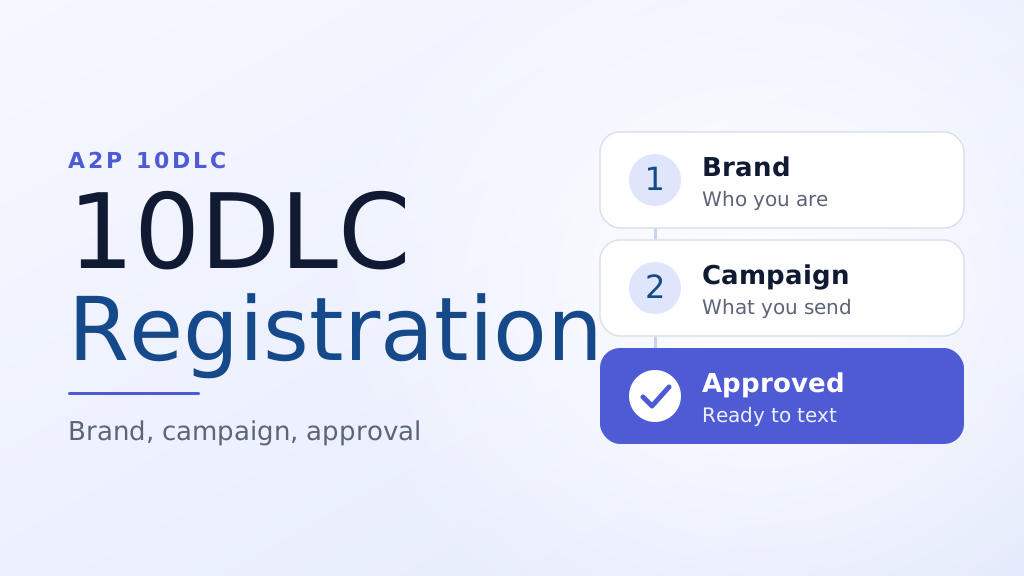
- Bạn đăng ký hai lần: a thương hiệu (danh tính doanh nghiệp của bạn) và một chiến dịch (bạn gửi gì và tại sao).
- Tên doanh nghiệp, mã số thuế và địa chỉ phải khớp chính xác với hồ sơ chính thức.
- Xóa tin nhắn mẫu, bằng chứng chọn tham gia rõ ràng, chính sách quyền riêng tư và các điều khoản sẽ ngăn chặn hầu hết các trường hợp bị từ chối.
- Thời gian phê duyệt khác nhau, vì vậy hãy đăng ký thật kỹ trước khi gửi số tiền lớn.
10DLC là gì?
10DLC là viết tắt của Mã dài 10 chữ số. Đó là số điện thoại tiêu chuẩn gồm 10 chữ số, như (559) 555-0123, mà doanh nghiệp có thể sử dụng để gửi tin nhắn văn bản cho khách hàng ở Hoa Kỳ.
Bạn sẽ thường thấy nó được viết là A2P 10DLC. A2P có nghĩa là ứng dụng tới người dùng: doanh nghiệp gửi văn bản từ phần mềm tới một người, thay vì người này gõ cho người khác. Nếu sự khác biệt đó là mới đối với bạn, hướng dẫn của chúng tôi về Nhắn tin A2P giải thích nó một cách chi tiết
Không giống như số điện thoại miễn phí hoặc mã ngắn, số 10DLC có vẻ cục bộ. Đó là lợi thế chính của nó. Khách hàng ở Dallas có nhiều khả năng nhận ra và tin tưởng số Texas hơn là một chuỗi chữ số dài.
Tại sao đăng ký 10DLC tồn tại
Nhiều năm trước, một doanh nghiệp có thể mua một số điện thoại địa phương và bắt đầu nhắn tin vào buổi chiều cùng ngày. Sự cởi mở đó cũng cho phép những kẻ gửi thư rác gửi khối lượng lớn từ những con số không thể theo dõi.
Các nhà mạng Mỹ đã phản hồi bằng cách đăng ký. Các doanh nghiệp gửi tin nhắn từ số 10DLC giờ đây sẽ cho nhà mạng biết họ là ai và họ dự định gửi những gì. Đổi lại, tin nhắn của họ nhận được cao hơn và dễ dự đoán hơn. Tin nhắn từ lưu lượng truy cập chưa đăng ký có thể bị lọc, làm chậm hoặc chặn và các nhà cung cấp dịch vụ sẽ tính thêm phí đối với lưu lượng truy cập chưa đăng ký.
Cơ quan đăng ký đằng sau quá trình này là Cơ quan đăng ký chiến dịch (TCR). Bạn thường không trực tiếp giải quyết nó. Nhà cung cấp dịch vụ nhắn tin gửi thông tin chi tiết của bạn tới TCR cho bạn.
Thương hiệu và Chiến dịch: Hai phần đăng ký
Việc đăng ký có hai phần và mọi người thường nhầm lẫn chúng.
Thương hiệu câu trả lời "bạn là ai?" Nó bao gồm tên doanh nghiệp hợp pháp, ID thuế, địa chỉ, trang web và chi tiết liên hệ của bạn.
Chiến dịch câu trả lời "bạn đang gửi cái gì và cho ai?" Nó bao gồm trường hợp sử dụng của bạn, tin nhắn mẫu và bằng chứng cho thấy mọi người đã chọn tham gia.
Một thương hiệu có thể có nhiều chiến dịch. Các thương hiệu tiêu chuẩn thường được phép sử dụng tối đa năm thương hiệu, trong khi các thương hiệu của chủ sở hữu duy nhất được giới hạn ở một. Một phòng khám có thể đăng ký một chiến dịch để nhắc nhở cuộc hẹn và một chiến dịch khác để khuyến mại, vì mỗi chiến dịch có mục đích và quy tắc khác nhau.
Trước khi bạn bắt đầu: Những gì cần chuẩn bị sẵn sàng
Hãy tập hợp những thứ này trước. Hầu hết sự chậm trễ đều đến từ thông tin bị thiếu hoặc không khớp chứ không phải từ nhà mạng.
| Những gì bạn cần | Tại sao nó quan trọng |
|---|---|
| Tên doanh nghiệp hợp pháp, chính xác như đã đăng ký | Nó phải khớp với hồ sơ chính thức của bạn, bao gồm cả dấu câu và hậu tố như "LLC" |
| EIN (ID thuế) cho doanh nghiệp hoặc thông tin cá nhân cho chủ sở hữu duy nhất | Dùng để xác minh doanh nghiệp |
| Địa chỉ doanh nghiệp | Phải phù hợp với hồ sơ chính thức |
| Một trang web đang hoạt động | Người đánh giá tìm kiếm sự hiện diện thực sự của doanh nghiệp |
| Chính sách bảo mật và các điều khoản được liên kết từ trang web của bạn | Nhiều chiến dịch bị từ chối nếu không có chúng |
| Mô tả chương trình nhắn tin của bạn | Giải thích rõ ràng, cụ thể về nội dung bạn gửi và lý do |
| Hai hoặc nhiều tin nhắn mẫu | They must reflect what you will actually send |
| Proof of opt-in | A screenshot or URL showing how customers agree to receive texts |
How to Register for 10DLC: Step by Step
Step 1: Pick the right brand type
Most businesses register as a standard brand with an EIN. Individuals without an EIN can usually register as a sole proprietor, which is faster but comes with lower message volume limits. If you plan to grow, register as a business from the start so you do not need to redo the process.
Step 2: Submit your brand details
Enter your legal name, tax ID, address and website. Compare each field against your tax records before you submit. Even a small mismatch, such as "Smith Plumbing" versus "Smith Plumbing LLC," can fail verification.
After submission, your brand receives a status and a trust score. A higher score usually means higher message throughput. Some businesses can pay for optional extra vetting to improve their score, which can matter if you plan to send high volumes.
Step 3: Choose a campaign use case
Campaigns are registered under a use case. Common ones include:
- Account notifications
- Customer care
- Thông báo giao hàng
- Two-factor authentication (one-time passcodes)
- Tiếp thị
- Fraud alerts
- Low volume mixed, for businesses that send a few kinds of messages in small amounts
Choose the one that matches what you really send. Registering as "customer care" and then sending promotions can lead to blocked messages later. Not sure where your messages fit? Our guide to SMS giao dịch shows how order, account and security texts differ from promotions.
Step 4: Write your campaign description and samples
Explain in plain language who your customers are, how they sign up and what messages they receive. Then write sample messages that sound like the real thing.
A strong sample usually includes your business name, a clear purpose and opt-out wording. For example:
“Harbor View Dental: Your cleaning is booked for Tue, Apr 8 at 9:30 AM. Reply C to confirm or R to reschedule. Reply STOP to opt out.”
The same goes for the campaign description. Compare these two:
- Too vague: "We send marketing messages to our customers."
- Clear and specific: "Harbor View Dental sends appointment confirmations and reminders to patients who book online or at the front desk and agree to receive texts. Patients can reply STOP at any time."
The second version tells a reviewer who you are, who receives the texts, how they opted in and what you send. That is exactly what they check.
Step 5: Show how customers opt in
Reviewers want to see consent. Provide a link or screenshot of the form, checkbox, keyword sign-up or paper form where customers agree to receive texts. The consent language should name your business and say what kinds of messages they will get and that message and data rates may apply.
Step 6: Submit and wait for review
Review times vary by provider and by how complete your submission is. Brand checks are usually quicker than campaign reviews, and a campaign can take from a few days to a few weeks. Ask your provider for its current estimate, and plan your launch around it instead of registering the day before a promotion.
Step 7: Connect your number and start sending
Once the campaign is approved, your 10DLC number is linked to it and you can send. Start with a small test group, check delivery reports, and then scale up.
Make your messages stand out with reliable, fast and effective communication. Elevate your texting game today.
Why Registrations Get Rejected
Most rejections follow the same few patterns. Check your submission against this list before you press submit.
- Name or EIN mismatch. The business name on your form differs from official records.
- No visible opt-in. There is no screenshot, form or URL showing consent.
- Missing privacy policy or terms. Reviewers look for them on your website.
- Vague descriptions. "We send marketing messages" does not explain anything. Say who, what, how often.
- Sample messages that do not match the use case. A promotional sample under an account-notification campaign is a red flag.
- Missing business name or opt-out language in samples. Include both.
- Public link shorteners. Free shorteners are commonly treated as a spam signal. Use your own domain.
- Restricted content. Carriers restrict categories such as cannabis, illegal content and certain high-risk offers like some lending and debt services. Messages in these areas often need special handling or are not allowed.
- Wrong volume estimates. Registering for a few hundred messages and sending tens of thousands creates problems.
If a submission is rejected, read the reason code, fix the specific issue and resubmit. A repeated failure for the same reason slows you down more than taking an extra day to get it right the first time.
What Registration Costs
Fees come from two places. Carriers and the registry charge for brand registration and campaign review, and providers may add their own charges. Some of these are one-time fees and some are monthly. Amounts change, so check your provider's current pricing instead of relying on a number from a blog post.
Budget for it as a normal cost of business texting. Unregistered traffic usually costs more per message anyway, and it risks blocked delivery.
10DLC vs Toll-Free vs Short Code
Registration is not the only way to text in the US. Which option you choose depends on your volume and goals.
| 10DLC | Số điện thoại miễn phí | Short code | |
|---|---|---|---|
| Looks like | Local 10-digit number | 800-style number | 5 or 6 digits |
| Tốt nhất cho | Local businesses, small and mid-sized volume | Customer support, national brands | Very high volume and fast throughput |
| Cài đặt | Brand and campaign registration | Toll-free verification | Application and carrier approval, usually the longest |
| Customer feel | Local and personal | Professional | High-volume campaign |
If you are leaning toward the high-volume route, our overview of the 22395 short code shows how short codes work in practice.
After You Are Approved: Staying Compliant
Registration is not a one-time finish line. Keep these habits:
- Send only what you registered. If your use case changes, register a new campaign.
- Honor opt-outs right away. When someone replies STOP, stop texting them.
- Keep consent records. Store the date, time and method of each opt-in. Our SMS marketing guide explains how to build a list people actually agree to join.
- Watch your delivery reports. A sudden drop in delivery can signal filtering.
- Respect send times. Avoid late-night promotions.
- Plan your sends. Once you are approved, our guide to running a bulk SMS campaign covers choosing features and measuring results.
Registering Through SMSLocal
If you send through SMSLocal, sender registration is handled for you during onboarding, so you do not have to work through the carrier process alone. You still know your business best, so have the details from the checklist above ready: your legal business name, tax ID, website, sample messages and opt-in proof. Contact the SMSLocal team if you want help reviewing them before you apply.
Phần kết luận
10DLC registration feels like paperwork, but it is what lets your texts reach customers reliably. Register your brand with details that match your official records, choose the right use case, write clear sample messages and document how people opt in.
Allow time for review, fix rejection reasons one by one and keep your program aligned with what you registered. A clean registration protects your delivery today and makes it easier to grow your texting later.
Start your free trial with SMSLocal and reach your customers with registered, reliable messages.
Câu hỏi thường gặp
If you send business texts to US recipients from a standard 10-digit local number, carriers expect you to register. Without registration, messages are likely to be filtered, blocked or charged higher fees. Toll-free numbers and short codes follow their own approval processes.
It varies. Brand checks are usually quicker, and campaign review can take from a few days to a few weeks. A complete, accurate submission is the best way to speed it up.
A brand is your business identity: name, tax ID, address and website. A campaign describes what you send, including the use case, sample messages and opt-in proof. One brand can run several campaigns.
Yes. Individuals without an EIN can usually register as sole proprietors. This route is simpler but allows only one campaign and lower daily volume, so businesses that expect to grow often register as standard brands.
The most common causes are a business name that does not match official records, missing opt-in proof, no privacy policy or terms, vague descriptions, sample messages that do not fit the use case, and public link shorteners. Review the rejection reason, correct that item and resubmit.
No. Message length works the same on every number type: 160 characters per segment in standard text, and 70 when a message contains an emoji or other special characters.