 English
Einführung
Ein Blumenladen richtet in der Woche vor dem Muttertag ein SMS-Geschäft ein. Der Besitzer lädt die Kundenliste, schreibt eine herzliche Nachricht über Vorbestellungen und drückt auf „Senden“. Auf dem Dashboard wird „gesendet“ angezeigt. Die Hälfte der Kunden bekommt es nie und der Rest kommt Stunden zu spät.
An der Nachricht ist nichts falsch. Der Shop hat einen Schritt übersprungen, den US-Betreiber mittlerweile von jedem Unternehmen erwarten, das SMS von einer regulären lokalen Nummer sendet: die 10DLC-Registrierung.
In diesem Leitfaden erfahren Sie, was 10DLC ist, warum es eine Registrierung gibt, was Sie vor dem Start benötigen, wie der Prozess von der Marke bis zur Kampagne abläuft und welche Fehler zur Ablehnung von Einsendungen führen. Wir haben es für kleine und mittlere US-Unternehmen geschrieben. Die gleichen Schritte gelten unabhängig davon, ob Sie sich selbst oder über einen Messaging-Anbieter wie SMSLocal registrieren.
Wichtige Erkenntnisse
- Durch die 10DLC-Registrierung erfahren US-Anbieter, wer Sie sind und was Sie per SMS senden möchten. Nicht registrierter Geschäftsverkehr wird stärker gefiltert und verursacht zusätzliche Gebühren des Mobilfunkanbieters.
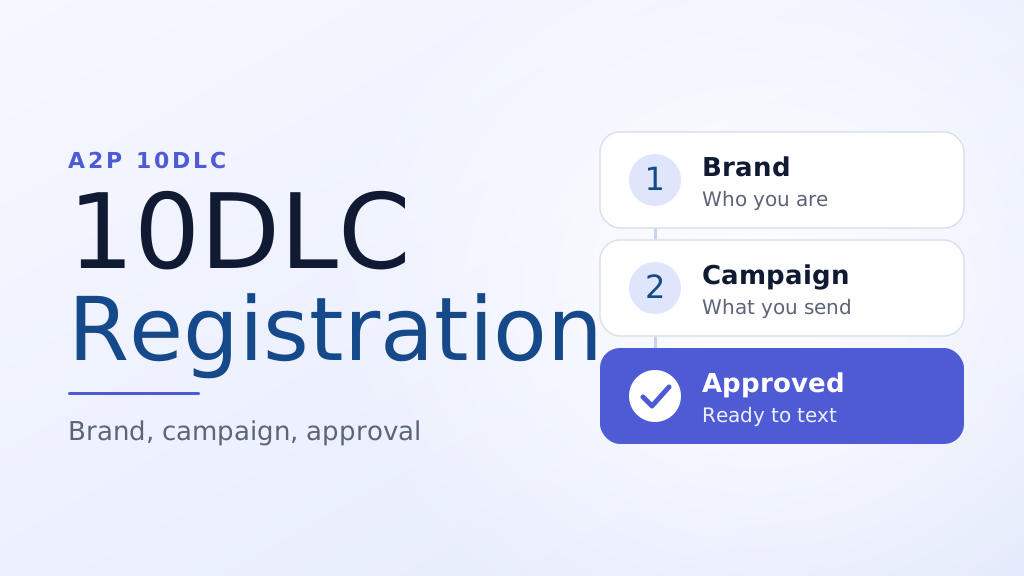
- Sie registrieren sich zweimal: a Marke (Ihre Geschäftsidentität) und a Kampagne (was Sie senden und warum).
- Firmennamen, Steuernummern und Adressen müssen genau mit den offiziellen Aufzeichnungen übereinstimmen.
- Klare Beispielnachrichten, ein sichtbarer Opt-in-Nachweis, eine Datenschutzerklärung und Bedingungen verhindern die meisten Ablehnungen.
- Die Genehmigungszeit variiert. Melden Sie sich daher rechtzeitig vor einem großen Versand an.
Was ist 10DLC?
10DLC steht für 10-stelliger Langcode. Dabei handelt es sich um die standardmäßige 10-stellige Telefonnummer, z. B. (559) 555-0123, über die Unternehmen Textnachrichten an Kunden in den USA senden können.
Sie werden es oft als geschrieben sehen A2P 10DLC. A2P bedeutet „Application-to-Person“: Ein Unternehmen sendet einen Text von der Software an eine Person, anstatt dass eine Person eine andere Person tippt. Wenn diese Unterscheidung für Sie neu ist, finden Sie hier unseren Leitfaden A2P-Nachrichtenübermittlung erklärt es ausführlich.
Im Gegensatz zu einer gebührenfreien Nummer oder einer Kurzwahlnummer sieht eine 10DLC-Nummer lokal aus. Das ist sein Hauptvorteil. Kunden in Dallas erkennen und vertrauen eher einer texanischen Nummer als einer langen Ziffernfolge.
Warum es eine 10DLC-Registrierung gibt
Vor Jahren konnte ein Unternehmen eine lokale Nummer kaufen und noch am selben Nachmittag mit dem Versenden von SMS beginnen. Diese Offenheit ermöglichte es Spammern auch, riesige Mengen von Nummern zu versenden, die nicht zurückverfolgt werden konnten.
US-amerikanische Fluggesellschaften antworteten mit einem Register. Unternehmen, die SMS von 10DLC-Nummern versenden, teilen den Netzbetreibern jetzt mit, wer sie sind und was sie versenden möchten. Im Gegenzug erhalten ihre Nachrichten eine höhere und vorhersehbarere Zustellung. Nachrichten aus nicht registriertem Datenverkehr können gefiltert, verlangsamt oder blockiert werden und die Netzbetreiber erheben zusätzliche Gebühren für nicht registrierten Datenverkehr.
Die Registrierung hinter dem Prozess ist Das Kampagnenregister (TCR). Normalerweise beschäftigt man sich nicht direkt damit. Ihr Messaging-Anbieter übermittelt Ihre Daten für Sie an TCR.
Marke und Kampagne: Die zwei Teile der Registrierung
Die Registrierung besteht aus zwei Teilen, die oft verwechselt werden.
Marke antwortet: „Wer bist du?“ Es umfasst Ihren Firmennamen, Ihre Steuernummer, Ihre Adresse, Ihre Website und Ihre Kontaktdaten.
Kampagne antwortet: „Was senden Sie und an wen?“ Es umfasst Ihren Anwendungsfall, Beispielnachrichten und den Nachweis, dass sich Personen dafür entschieden haben.
Eine Marke kann mehr als eine Kampagne haben. Standardmarken sind in der Regel bis zu fünf erlaubt, während Einzelmarken auf eine beschränkt sind. Eine Klinik könnte eine Kampagne für Terminerinnerungen und eine andere für Werbeangebote registrieren, da jede Kampagne einen anderen Zweck und andere Regeln hat.
Bevor Sie beginnen: Was Sie bereithalten sollten
Sammeln Sie diese zuerst. Die meisten Verzögerungen sind auf fehlende oder nicht übereinstimmende Informationen zurückzuführen, nicht auf Seiten der Spediteure.
| Was Sie brauchen | Warum es wichtig ist |
|---|---|
| Rechtsgültiger Firmenname, genau wie eingetragen | Es muss mit Ihren offiziellen Unterlagen übereinstimmen, einschließlich Satzzeichen und Suffixen wie „LLC“. |
| EIN (Steuer-ID) für ein Unternehmen oder persönliche Daten für einen Einzelunternehmer | Wird zur Verifizierung des Unternehmens verwendet |
| Geschäftsadresse | Muss mit offiziellen Aufzeichnungen übereinstimmen |
| Eine funktionierende Website | Rezensenten achten auf eine echte Geschäftspräsenz |
| Datenschutzrichtlinien und -bedingungen, die auf Ihrer Website verlinkt sind | Viele Kampagnen werden ohne sie abgelehnt |
| Beschreibung Ihres SMS-Programms | A clear, specific explanation of what you send and why |
| Two or more sample messages | They must reflect what you will actually send |
| Proof of opt-in | A screenshot or URL showing how customers agree to receive texts |
How to Register for 10DLC: Step by Step
Step 1: Pick the right brand type
Most businesses register as a standard brand with an EIN. Individuals without an EIN can usually register as a sole proprietor, which is faster but comes with lower message volume limits. If you plan to grow, register as a business from the start so you do not need to redo the process.
Step 2: Submit your brand details
Enter your legal name, tax ID, address and website. Compare each field against your tax records before you submit. Even a small mismatch, such as "Smith Plumbing" versus "Smith Plumbing LLC," can fail verification.
After submission, your brand receives a status and a trust score. A higher score usually means higher message throughput. Some businesses can pay for optional extra vetting to improve their score, which can matter if you plan to send high volumes.
Step 3: Choose a campaign use case
Campaigns are registered under a use case. Common ones include:
- Account notifications
- Customer care
- Lieferbenachrichtigungen
- Two-factor authentication (one-time passcodes)
- Marketing
- Fraud alerts
- Low volume mixed, for businesses that send a few kinds of messages in small amounts
Choose the one that matches what you really send. Registering as "customer care" and then sending promotions can lead to blocked messages later. Not sure where your messages fit? Our guide to Transaktions-SMS shows how order, account and security texts differ from promotions.
Step 4: Write your campaign description and samples
Explain in plain language who your customers are, how they sign up and what messages they receive. Then write sample messages that sound like the real thing.
A strong sample usually includes your business name, a clear purpose and opt-out wording. For example:
“Harbor View Dental: Your cleaning is booked for Tue, Apr 8 at 9:30 AM. Reply C to confirm or R to reschedule. Reply STOP to opt out.”
The same goes for the campaign description. Compare these two:
- Too vague: "We send marketing messages to our customers."
- Clear and specific: "Harbor View Dental sends appointment confirmations and reminders to patients who book online or at the front desk and agree to receive texts. Patients can reply STOP at any time."
The second version tells a reviewer who you are, who receives the texts, how they opted in and what you send. That is exactly what they check.
Step 5: Show how customers opt in
Reviewers want to see consent. Provide a link or screenshot of the form, checkbox, keyword sign-up or paper form where customers agree to receive texts. The consent language should name your business and say what kinds of messages they will get and that message and data rates may apply.
Step 6: Submit and wait for review
Review times vary by provider and by how complete your submission is. Brand checks are usually quicker than campaign reviews, and a campaign can take from a few days to a few weeks. Ask your provider for its current estimate, and plan your launch around it instead of registering the day before a promotion.
Step 7: Connect your number and start sending
Once the campaign is approved, your 10DLC number is linked to it and you can send. Start with a small test group, check delivery reports, and then scale up.
Make your messages stand out with reliable, fast and effective communication. Elevate your texting game today.
Why Registrations Get Rejected
Most rejections follow the same few patterns. Check your submission against this list before you press submit.
- Name or EIN mismatch. The business name on your form differs from official records.
- No visible opt-in. There is no screenshot, form or URL showing consent.
- Missing privacy policy or terms. Reviewers look for them on your website.
- Vague descriptions. "We send marketing messages" does not explain anything. Say who, what, how often.
- Sample messages that do not match the use case. A promotional sample under an account-notification campaign is a red flag.
- Missing business name or opt-out language in samples. Include both.
- Public link shorteners. Free shorteners are commonly treated as a spam signal. Use your own domain.
- Restricted content. Carriers restrict categories such as cannabis, illegal content and certain high-risk offers like some lending and debt services. Messages in these areas often need special handling or are not allowed.
- Wrong volume estimates. Registering for a few hundred messages and sending tens of thousands creates problems.
If a submission is rejected, read the reason code, fix the specific issue and resubmit. A repeated failure for the same reason slows you down more than taking an extra day to get it right the first time.
What Registration Costs
Fees come from two places. Carriers and the registry charge for brand registration and campaign review, and providers may add their own charges. Some of these are one-time fees and some are monthly. Amounts change, so check your provider's current pricing instead of relying on a number from a blog post.
Budget for it as a normal cost of business texting. Unregistered traffic usually costs more per message anyway, and it risks blocked delivery.
10DLC vs Toll-Free vs Short Code
Registration is not the only way to text in the US. Which option you choose depends on your volume and goals.
| 10DLC | Gebührenfrei | Short code | |
|---|---|---|---|
| Looks like | Local 10-digit number | 800-style number | 5 or 6 digits |
| Am besten für | Local businesses, small and mid-sized volume | Customer support, national brands | Very high volume and fast throughput |
| Aufstellen | Brand and campaign registration | Toll-free verification | Application and carrier approval, usually the longest |
| Customer feel | Local and personal | Professional | High-volume campaign |
If you are leaning toward the high-volume route, our overview of the 22395 short code shows how short codes work in practice.
After You Are Approved: Staying Compliant
Registration is not a one-time finish line. Keep these habits:
- Send only what you registered. If your use case changes, register a new campaign.
- Honor opt-outs right away. When someone replies STOP, stop texting them.
- Keep consent records. Store the date, time and method of each opt-in. Our SMS marketing guide explains how to build a list people actually agree to join.
- Watch your delivery reports. A sudden drop in delivery can signal filtering.
- Respect send times. Avoid late-night promotions.
- Plan your sends. Once you are approved, our guide to running a bulk SMS campaign covers choosing features and measuring results.
Registering Through SMSLocal
If you send through SMSLocal, sender registration is handled for you during onboarding, so you do not have to work through the carrier process alone. You still know your business best, so have the details from the checklist above ready: your legal business name, tax ID, website, sample messages and opt-in proof. Contact the SMSLocal team if you want help reviewing them before you apply.
Abschluss
10DLC registration feels like paperwork, but it is what lets your texts reach customers reliably. Register your brand with details that match your official records, choose the right use case, write clear sample messages and document how people opt in.
Allow time for review, fix rejection reasons one by one and keep your program aligned with what you registered. A clean registration protects your delivery today and makes it easier to grow your texting later.
Start your free trial with SMSLocal and reach your customers with registered, reliable messages.
Häufig gestellte Fragen
If you send business texts to US recipients from a standard 10-digit local number, carriers expect you to register. Without registration, messages are likely to be filtered, blocked or charged higher fees. Toll-free numbers and short codes follow their own approval processes.
It varies. Brand checks are usually quicker, and campaign review can take from a few days to a few weeks. A complete, accurate submission is the best way to speed it up.
A brand is your business identity: name, tax ID, address and website. A campaign describes what you send, including the use case, sample messages and opt-in proof. One brand can run several campaigns.
Yes. Individuals without an EIN can usually register as sole proprietors. This route is simpler but allows only one campaign and lower daily volume, so businesses that expect to grow often register as standard brands.
The most common causes are a business name that does not match official records, missing opt-in proof, no privacy policy or terms, vague descriptions, sample messages that do not fit the use case, and public link shorteners. Review the rejection reason, correct that item and resubmit.
No. Message length works the same on every number type: 160 characters per segment in standard text, and 70 when a message contains an emoji or other special characters.