 English
Introduzione
Un negozio di fiori avvia un'attività inviando SMS la settimana prima della festa della mamma. Il proprietario carica l'elenco dei clienti, scrive un messaggio caloroso sui preordini e preme Invia. La dashboard dice "inviato". La metà dei clienti non lo riceve mai e il resto arriva con ore di ritardo.
Non c'è niente di sbagliato nel messaggio. Il negozio ha saltato un passaggio che gli operatori statunitensi ora si aspettano da ogni azienda che invia messaggi da un normale numero locale: la registrazione 10DLC.
Questa guida illustra cos'è 10DLC, perché esiste la registrazione, di cosa hai bisogno prima di iniziare, come si svolge il processo dal marchio alla campagna e gli errori che portano al rifiuto degli invii. L'abbiamo scritto per le piccole e medie imprese statunitensi e gli stessi passaggi si applicano sia che ti registri personalmente o tramite un provider di messaggistica come SMSLocal.
Punti chiave
- La registrazione 10DLC indica agli operatori statunitensi chi sei e cosa intendi inviare. Il traffico aziendale non registrato viene filtrato più pesantemente e comporta commissioni aggiuntive per il vettore.
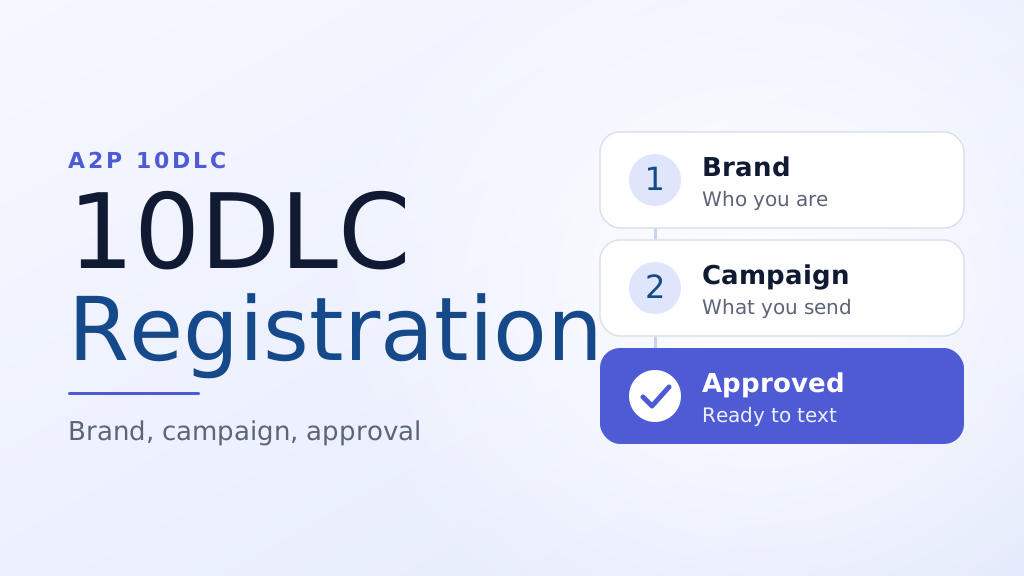
- Ti registri due volte: a marca (la tua identità aziendale) e a campagna (cosa invii e perché).
- I nomi delle aziende, i codici fiscali e gli indirizzi devono corrispondere esattamente ai registri ufficiali.
- Messaggi campione chiari, prove visibili di adesione, una politica sulla privacy e termini prevengono la maggior parte dei rifiuti.
- Il tempo di approvazione varia, quindi registrati molto prima di un grande invio.
Cos'è 10DLC?
10DLC sta per Codice lungo 10 cifre. È il numero di telefono standard di 10 cifre, come (559) 555-0123, che le aziende possono utilizzare per inviare messaggi di testo ai clienti negli Stati Uniti.
Lo vedrai spesso scritto come A2P 10DLC. A2P significa applicazione a persona: un'azienda invia un testo dal software a una persona, anziché una persona che lo digita a un'altra. Se questa distinzione è nuova per te, la nostra guida a Messaggistica A2P lo spiega in dettaglio.
A differenza di un numero verde o di un codice breve, un numero 10DLC sembra locale. Questo è il suo principale vantaggio. È più probabile che i clienti di Dallas riconoscano e si fidino di un numero del Texas piuttosto che di una lunga serie di cifre.
Perché esiste la registrazione 10DLC
Anni fa, un'azienda poteva acquistare un numero locale e iniziare a inviare messaggi lo stesso pomeriggio. Questa apertura ha inoltre consentito agli spammer di inviare enormi volumi da numeri impossibili da rintracciare.
I vettori statunitensi hanno risposto con un registro. Le aziende che inviano SMS da numeri 10DLC ora dicono ai corrieri chi sono e cosa intendono inviare. In cambio, i loro messaggi ricevono una consegna più elevata e più prevedibile. I messaggi provenienti da traffico non registrato possono essere filtrati, rallentati o bloccati e gli operatori addebitano costi aggiuntivi sul traffico non registrato.
Il registro dietro il processo è Il registro delle campagne (TCR). Di solito non te ne occupi direttamente. Il tuo provider di messaggistica invia i tuoi dati a TCR per te.
Marchio e campagna: i due pezzi della registrazione
La registrazione è composta da due parti e le persone spesso le confondono.
Marca risponde "chi sei?" Copre la ragione sociale legale, il codice fiscale, l'indirizzo, il sito web e i dettagli di contatto.
Campagna risponde "cosa stai inviando e a chi?" Copre il caso d'uso, i messaggi di esempio e la prova che le persone hanno aderito.
Un marchio può avere più di una campagna. I marchi standard sono comunemente consentiti fino a cinque, mentre i marchi di proprietà individuale sono limitati a uno. Una clinica potrebbe registrare una campagna per i promemoria degli appuntamenti e un'altra per le offerte promozionali, perché ciascuna ha uno scopo diverso e regole diverse.
Prima di iniziare: cosa tenere pronto
Raccoglili prima. La maggior parte dei ritardi deriva da informazioni mancanti o non corrispondenti, non dai corrieri.
| Di cosa hai bisogno | Perché è importante |
|---|---|
| Ragione sociale legale, esattamente come registrata | Deve corrispondere ai dati ufficiali, inclusi punteggiatura e suffissi come "LLC" |
| EIN (codice fiscale) per un'azienda o dati personali per un unico proprietario | Utilizzato per verificare l'attività |
| Indirizzo commerciale | Deve corrispondere ai record ufficiali |
| Un sito web funzionante | I revisori cercano una reale presenza aziendale |
| Informativa sulla privacy e termini collegati dal tuo sito | Molte campagne vengono rifiutate senza di esse |
| Descrizione del tuo programma di messaggistica | Una spiegazione chiara e specifica di ciò che invii e perché |
| Due o più messaggi di esempio | They must reflect what you will actually send |
| Proof of opt-in | A screenshot or URL showing how customers agree to receive texts |
How to Register for 10DLC: Step by Step
Step 1: Pick the right brand type
Most businesses register as a standard brand with an EIN. Individuals without an EIN can usually register as a sole proprietor, which is faster but comes with lower message volume limits. If you plan to grow, register as a business from the start so you do not need to redo the process.
Step 2: Submit your brand details
Enter your legal name, tax ID, address and website. Compare each field against your tax records before you submit. Even a small mismatch, such as "Smith Plumbing" versus "Smith Plumbing LLC," can fail verification.
After submission, your brand receives a status and a trust score. A higher score usually means higher message throughput. Some businesses can pay for optional extra vetting to improve their score, which can matter if you plan to send high volumes.
Step 3: Choose a campaign use case
Campaigns are registered under a use case. Common ones include:
- Account notifications
- Customer care
- Notifiche di consegna
- Two-factor authentication (one-time passcodes)
- Marketing
- Fraud alerts
- Low volume mixed, for businesses that send a few kinds of messages in small amounts
Choose the one that matches what you really send. Registering as "customer care" and then sending promotions can lead to blocked messages later. Not sure where your messages fit? Our guide to SMS transazionali shows how order, account and security texts differ from promotions.
Step 4: Write your campaign description and samples
Explain in plain language who your customers are, how they sign up and what messages they receive. Then write sample messages that sound like the real thing.
A strong sample usually includes your business name, a clear purpose and opt-out wording. For example:
“Harbor View Dental: Your cleaning is booked for Tue, Apr 8 at 9:30 AM. Reply C to confirm or R to reschedule. Reply STOP to opt out.”
The same goes for the campaign description. Compare these two:
- Too vague: "We send marketing messages to our customers."
- Clear and specific: "Harbor View Dental sends appointment confirmations and reminders to patients who book online or at the front desk and agree to receive texts. Patients can reply STOP at any time."
The second version tells a reviewer who you are, who receives the texts, how they opted in and what you send. That is exactly what they check.
Step 5: Show how customers opt in
Reviewers want to see consent. Provide a link or screenshot of the form, checkbox, keyword sign-up or paper form where customers agree to receive texts. The consent language should name your business and say what kinds of messages they will get and that message and data rates may apply.
Step 6: Submit and wait for review
Review times vary by provider and by how complete your submission is. Brand checks are usually quicker than campaign reviews, and a campaign can take from a few days to a few weeks. Ask your provider for its current estimate, and plan your launch around it instead of registering the day before a promotion.
Step 7: Connect your number and start sending
Once the campaign is approved, your 10DLC number is linked to it and you can send. Start with a small test group, check delivery reports, and then scale up.
Make your messages stand out with reliable, fast and effective communication. Elevate your texting game today.
Why Registrations Get Rejected
Most rejections follow the same few patterns. Check your submission against this list before you press submit.
- Name or EIN mismatch. The business name on your form differs from official records.
- No visible opt-in. There is no screenshot, form or URL showing consent.
- Missing privacy policy or terms. Reviewers look for them on your website.
- Vague descriptions. "We send marketing messages" does not explain anything. Say who, what, how often.
- Sample messages that do not match the use case. A promotional sample under an account-notification campaign is a red flag.
- Missing business name or opt-out language in samples. Include both.
- Public link shorteners. Free shorteners are commonly treated as a spam signal. Use your own domain.
- Restricted content. Carriers restrict categories such as cannabis, illegal content and certain high-risk offers like some lending and debt services. Messages in these areas often need special handling or are not allowed.
- Wrong volume estimates. Registering for a few hundred messages and sending tens of thousands creates problems.
If a submission is rejected, read the reason code, fix the specific issue and resubmit. A repeated failure for the same reason slows you down more than taking an extra day to get it right the first time.
What Registration Costs
Fees come from two places. Carriers and the registry charge for brand registration and campaign review, and providers may add their own charges. Some of these are one-time fees and some are monthly. Amounts change, so check your provider's current pricing instead of relying on a number from a blog post.
Budget for it as a normal cost of business texting. Unregistered traffic usually costs more per message anyway, and it risks blocked delivery.
10DLC vs Toll-Free vs Short Code
Registration is not the only way to text in the US. Which option you choose depends on your volume and goals.
| 10 DLC | Numero verde gratuito | Short code | |
|---|---|---|---|
| Looks like | Local 10-digit number | 800-style number | 5 or 6 digits |
| Meglio per | Local businesses, small and mid-sized volume | Customer support, national brands | Very high volume and fast throughput |
| Impostare | Brand and campaign registration | Toll-free verification | Application and carrier approval, usually the longest |
| Customer feel | Local and personal | Professional | High-volume campaign |
If you are leaning toward the high-volume route, our overview of the 22395 short code shows how short codes work in practice.
After You Are Approved: Staying Compliant
Registration is not a one-time finish line. Keep these habits:
- Send only what you registered. If your use case changes, register a new campaign.
- Honor opt-outs right away. When someone replies STOP, stop texting them.
- Keep consent records. Store the date, time and method of each opt-in. Our SMS marketing guide explains how to build a list people actually agree to join.
- Watch your delivery reports. A sudden drop in delivery can signal filtering.
- Respect send times. Avoid late-night promotions.
- Plan your sends. Once you are approved, our guide to running a bulk SMS campaign covers choosing features and measuring results.
Registering Through SMSLocal
If you send through SMSLocal, sender registration is handled for you during onboarding, so you do not have to work through the carrier process alone. You still know your business best, so have the details from the checklist above ready: your legal business name, tax ID, website, sample messages and opt-in proof. Contact the SMSLocal team if you want help reviewing them before you apply.
Conclusione
10DLC registration feels like paperwork, but it is what lets your texts reach customers reliably. Register your brand with details that match your official records, choose the right use case, write clear sample messages and document how people opt in.
Allow time for review, fix rejection reasons one by one and keep your program aligned with what you registered. A clean registration protects your delivery today and makes it easier to grow your texting later.
Start your free trial with SMSLocal and reach your customers with registered, reliable messages.
Domande frequenti
If you send business texts to US recipients from a standard 10-digit local number, carriers expect you to register. Without registration, messages are likely to be filtered, blocked or charged higher fees. Toll-free numbers and short codes follow their own approval processes.
It varies. Brand checks are usually quicker, and campaign review can take from a few days to a few weeks. A complete, accurate submission is the best way to speed it up.
A brand is your business identity: name, tax ID, address and website. A campaign describes what you send, including the use case, sample messages and opt-in proof. One brand can run several campaigns.
Yes. Individuals without an EIN can usually register as sole proprietors. This route is simpler but allows only one campaign and lower daily volume, so businesses that expect to grow often register as standard brands.
The most common causes are a business name that does not match official records, missing opt-in proof, no privacy policy or terms, vague descriptions, sample messages that do not fit the use case, and public link shorteners. Review the rejection reason, correct that item and resubmit.
No. Message length works the same on every number type: 160 characters per segment in standard text, and 70 when a message contains an emoji or other special characters.